













Everyone, regardless of if they read it or not, is likely familiar with the story of The Iliad. Homer’s epic recount of the Trojan War in all its drama and glory has persisted as one of the most essential works in the ancient literary canon. It’s been dissected and recounted across generations, but perhaps an underrepresented facet of these retellings concerns the grisly tragedy within. Most notably of all, is the lack of conversation surrounding the experiences of the women most affected by the mythical war. The Trojan Women serves as a chilling response, a play that dissects the aftermath of the Trojan War, performed by Fort Hamilton’s very own Drama Department.
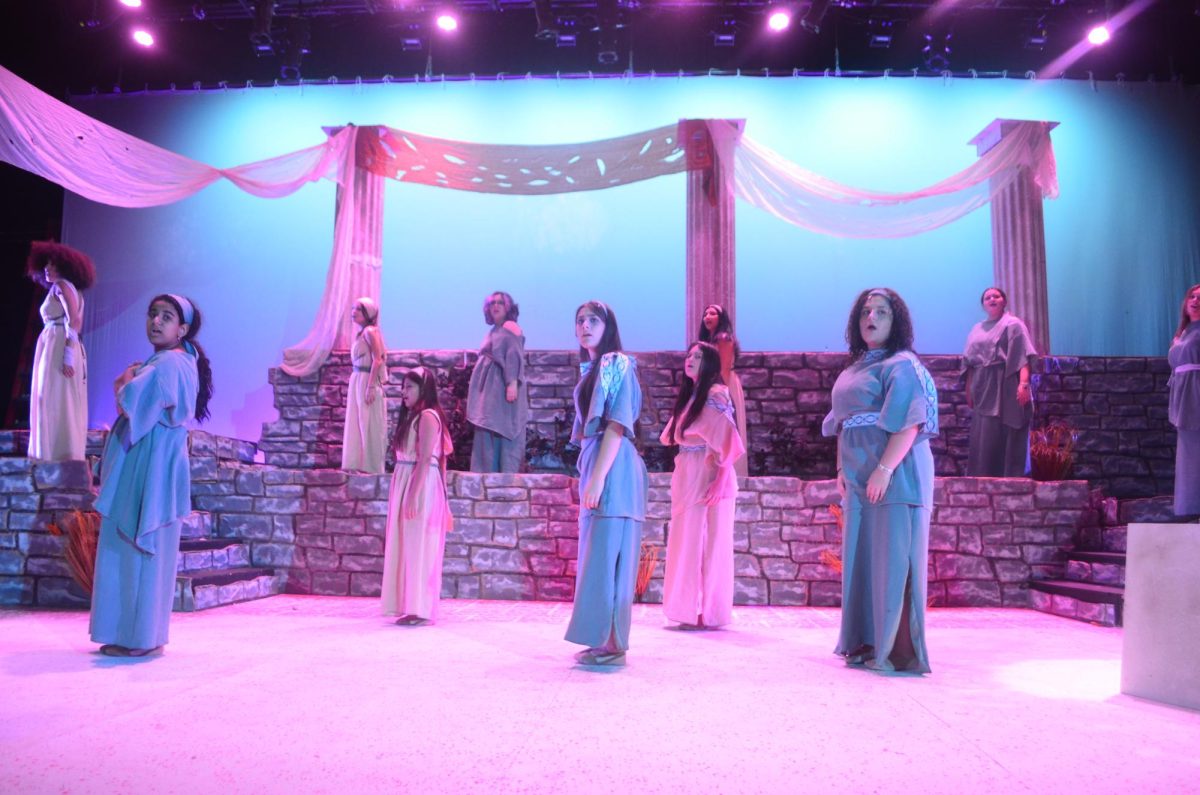
A powerful drama written by Euripides as a reaction to the Siege of Melos amidst the Peloponnesian War, The Trojan Women is a tragic tale about the fate of the women left behind. Those who survived the carnage and brutality of the war are forced to wait as they are slated to be sold into slavery. Involved in this tragic tale are the Greek gods Poseidon and Athena who must contend with the horrors of this situation; they provide a prologue to the story. Despite being a play with dramatic monologues and solemn soliloquies, musical numbers are incorporated in the Fort production to tell the story. The surviving Trojans sing and dance to communicate their despair in face of imminent doom.
Behind the spectacle on stage lies the beating heart of the production, the dedicated crew that works behind the scenes to immerse the audience in the foreign world of Ancient Greece. The set is wartorn, with stone walls and broken pillars to establish the lost glory of Troy. The entire play takes place in one location on the beach, never straying nor showing the full destruction. Senior Emma Tang serves as Head of Props for Fort’s production, overseeing the historical accuracy of the stage and implementing design choices to build the world beyond the stage.
“I worked with the set crew to design a common theme for the tech designs, destruction, and loss,” she said. “Many of the props I designed are purposefully cracked, frayed and painted with moody colors to symbolize the Trojan Women‘s collective feelings of hopelessness.” Each choice made was purposeful, with the intention of creating an atmosphere that the audience could connect to personally. The set design serves to supplement the bleak and emotive performances of the cast, portraying these emotionally complex women in a revealing and humanizing light.
The actors, in roles ranging from soldiers to former royals, developed their interpretations of a story that, while unfamiliar, is interpreted through their performances. Alex Rossicone, who plays Talthybius, notes that they “didn’t really get the emotion until we’d practiced it for a couple of weeks,” but they found their own personal connections to their characters and the emotional crux of the play. They researched the historical context surrounding their characters to act in a way that is conscious of the period and their perspectives. Their emotions are at the forefront of this play and make up a significant portion of the runtime, leaving room for them to fully display their inner thoughts and feelings for the audience to see. They use it to their fullest extent, with Aaliyah Mosquera’s portrayal of the grieving widow Andromache particularly heartrending. Aligned with the message of the play, these women are given the opportunity to tell their story and be heard.
But the play never strays from its central themes of humanity and personal autonomy. It’s this enduring connection to decidedly relevant issues that causes The Trojan Women to remain preserved as a timeless piece of drama that continues to be performed to this day. “Armed conflict is still very relevant now, there’s a lot of cruelty,” said Hecuba actress Izzy Balsamello, who serves as the lynchpin of the play with her performance as a former queen reduced to a slave. Her desperation in clinging to her humanity introduces a human aspect into this tragedy about war. Despite advancements made in warfare, there is still a persistent grief that the production highlights; one that is universal amongst victims of violence around the world. As it so happened, the performance schedule coincided with the week of Veterans’ Day, which was acknowledged by Mx. Shields as they addressed the audience with a moment of silence.
Before every show, the cast and crew form a circle and pay tribute to acting coach Uta Hagen. Clasping hands and closing eyes, they squeeze hands in succession as a “pulse” circle around, connecting each member mindfully before they embark on stage. While adapting such a complicated play could be daunting for some, Mx. Shields and the Drama Department here at Fort Hamilton have proven to have approached The Trojan Women with the respect and understanding necessary to stage a worthy production.