



















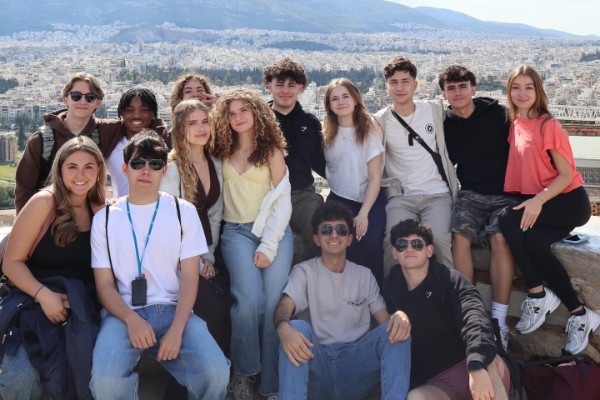
Over spring break, a group of Fort Hamilton students traveled across Greece on a trip organized by Mr. DeLisi, exploring a country where ancient history and modern culture exist side by side. From the ruins of Athens to the cliffs of Santorini, the experience offered a firsthand look at landmarks once confined only to textbooks.
The journey began in Athens, Greece’s capital and a city rich with history. A guided tour led students through key sites, including the Panathenaic Stadium and Syntagma Square, before culminating at the Acropolis. There, the Parthenon and the Temple of Athena Nike stood as enduring symbols of ancient Greek civilization. A visit to the Acropolis Museum provided further context, showcasing artifacts that date back thousands of years.
Beyond historical exploration, students also experienced Greek culture through food. During a cooking class, they prepared traditional dishes such as spanakopita, tzatziki and dakos salad, gaining insight into the fresh ingredients and simple techniques that bring out the bold, vibrant flavors of Mediterranean cuisine. Outside of structured meals, however, one dish quickly became a group staple: gyros. Whether between tours or late in the evening, they appeared so frequently that by the end of the trip, ordering one felt less like a choice and more like an everyday occurrence.
The trip continued with a visit to Delphi, once considered the center of the ancient world. Set against a mountainous backdrop, the archaeological site includes the Temple of Apollo and a museum housing significant relics of ancient Greece. On the return to Athens, a stop in the Amfissa Valley allowed students to tour an olive farm, where they sampled locally grown olives and olive oil — staples of Greek agriculture and diet.
From Athens, the group flew to Crete, Greece’s largest island. At the Palace of Knossos, students explored the remains of a Minoan complex often associated with the myth of the Minotaur. In the coastal town of Elounda, a boat tour brought them to Spinalonga, an historic island that has served as both a Venetian fortress and a leper colony, reflecting the region’s layered history.
The next destination was Santorini, known for its dramatic landscapes and iconic architecture. In the village of Oia, whitewashed buildings and blue-domed churches overlook the Aegean Sea, making it one of the most recognizable locations in Greece. Students also visited the archaeological site of Akrotiri, a well-preserved ancient settlement, and explored Pyrgos, a hilltop village offering panoramic views of the island. A boat excursion to the Santorini volcano and its hot springs highlighted the island’s volcanic origins.
The trip concluded back on the mainland with a visit to Cape Sounion, where the Temple of Poseidon stands above the sea. The site provided a final example of how Greece’s natural landscape and historical significance are closely intertwined.
Through guided tours, cultural experiences and time for exploration, the trip offered students a broader understanding of Greece beyond the classroom, connecting historical knowledge with real-world context.